What follows is a generalized walkthrough of how a well-run, appointment-and-walk-in tattoo studio typically structures its day—not a description of any single named business. The details reflect standard industry practice around sanitation and client flow that professional studios in Las Vegas, and everywhere else, are expected to follow.
Before the Doors Open: Setup and Sterilization Checks
A studio’s day does not start when the first client walks in. Before opening, staff typically run through a setup routine that includes checking the previous night’s autoclave cycle (the machine used to sterilize reusable equipment), confirming sharps containers are not near capacity and swapping them out if they are, and restocking single-use items—needle cartridges, ink caps, barrier film, gloves—so nothing runs short mid-session later in the day.
Many studios periodically run a spore test on their autoclave: a biological indicator strip that confirms the machine is actually reaching a true sterilization temperature and hold time, not simply completing a cycle. This is a background quality check clients rarely see, but it is one of the more meaningful indicators of a studio’s actual sanitation standards, as opposed to surface-level cleanliness.
Setting Up an Individual Station
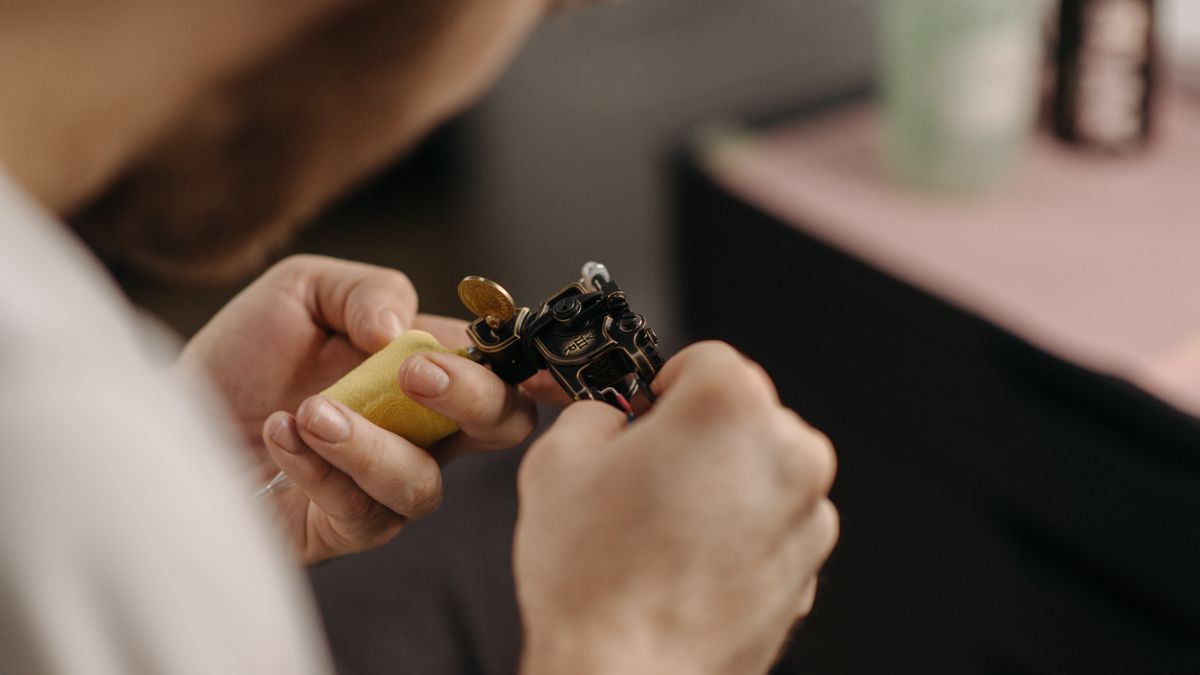
Before each client sits down, the artist sets up their individual station from scratch, regardless of how recently it was last used. This typically includes wiping down all surfaces with an appropriate disinfectant, then covering high-touch items—the machine grip, clip cord, spray bottles, tray, and adjustable light—with disposable plastic barrier film. The idea is straightforward: anything the artist might touch mid-tattoo with a gloved (and potentially ink- or blood-contaminated) hand needs either a barrier that gets thrown away afterward, or to be something that itself gets sterilized between uses.
Needle cartridges and ink caps are opened at the station, in front of the client, directly from sealed sterile packaging. This is standard practice specifically so the client can see the seal being broken rather than trusting that it already happened out of sight.
The Consultation-to-Tattoo Handoff
For appointment clients, the day’s schedule usually includes some buffer between a consultation (or a design finalization for returning clients) and the actual tattooing. During this window, the artist prints or transfers the final stencil, and the client reviews placement while the stencil is still adjustable, before any ink goes into the skin.
Walk-in clients follow a compressed version of the same process: a quick style discussion, a stencil applied from existing flash designs, and immediate placement approval, since walk-in traffic is generally suited to simpler, faster pieces rather than highly custom work.
During the Tattoo: Maintaining a Clean Field
Throughout the session, a professional artist maintains what is sometimes called a “clean field”—a working area where sterile and non-sterile items are kept clearly separated. In practice that means:
- Gloves are changed any time the artist touches something outside the immediate sterile setup—answering a phone, adjusting a chair, touching their own face.
- Excess ink and plasma are wiped with clean, single-use gauze or paper towels rather than a reused cloth.
- Any item that touches the client’s skin and cannot be sterilized between uses (certain grips, adjustable furniture surfaces) stays wrapped in barrier film for the entire session.
Between Clients: The Turnover Process
This is the part of the day most invisible to clients and most important to a studio’s actual safety record. Between every single client—not just at the end of the day—a professional studio performs a full station turnover:
- All barrier film is removed and discarded.
- Used needle cartridges go directly into a sharps container; they are never set down on a counter or reused, even briefly.
- Reusable equipment is pre-cleaned and sent for autoclave sterilization before its next use.
- Surfaces are disinfected again, and new barrier film is applied fresh for the next client, even if the next client is arriving within minutes.
Cross-contamination risk in tattooing comes almost entirely from skipping or rushing this turnover step—reusing something that should have been single-use, or treating a barrier-filmed surface as though it were already clean underneath. A studio that maintains the same turnover discipline during a fully booked Saturday as during a slow Tuesday afternoon is demonstrating real, tested sanitation practice rather than sanitation as a talking point.
Handling the Unexpected
Professional studios also have a standard response for the situations that occasionally come up over a normal day: a client who arrives visibly intoxicated (turned away, per the industry norm, both for legal-consent reasons and for the practical fact that alcohol thins blood and complicates the tattooing process), a design request that will not translate well to the chosen body part (an honest conversation before proceeding, not after), or a walk-in requesting something too complex for same-day work (redirected to book a proper consultation instead).
Closing the Day
At close, the routine mirrors the opening setup in reverse: final stations are broken down and disinfected regardless of whether they will be used again that night, sharps containers are checked, the day’s autoclave loads are run, and single-use inventory is checked against what is left for the next day. None of this is a special end-of-week deep clean—it happens after every single business day, because the alternative is starting the next morning with unknowns about what state the equipment is actually in.
The Regulatory Backdrop Behind the Routine
This turnover discipline is not simply good manners—it is what studios are expected to demonstrate under OSHA’s Bloodborne Pathogen Standard, which governs any workplace where staff may be exposed to blood or other potentially infectious materials, layered on top of local health authority body art permitting requirements. In the Las Vegas Valley, that generally means periodic inspections from the applicable county health authority, which can include reviewing sterilization logs, checking sharps disposal practices, and confirming that single-use items are actually being used once. A studio that keeps its equipment and disposal logs in order is not just being careful for its own sake; it is maintaining the paperwork trail that a health inspection would actually check.
Frequently Asked Questions
Can a client ask to watch the sterile setup happen?
Yes. It is a normal request, and a professional artist will not treat it as an inconvenience. Watching a needle cartridge come out of its sealed package, or seeing fresh barrier film applied at your specific station, is a reasonable way to confirm standard practice firsthand.
Does a busy, fully booked day increase contamination risk?
It can, if a studio cuts corners under time pressure—which is exactly why the between-client turnover routine is meant to be identical regardless of how busy the day is. A studio that visibly rushes station turnover during peak hours is a legitimate reason for concern, even if its practices look fine during a slow period.
How often is equipment actually sterilized versus just wiped down?
Single-use items (needles, ink caps, razors) are never sterilized for reuse—they are disposed of after one use, full stop. Reusable equipment that cannot be single-use (certain grips or tube systems, if a studio uses them) is fully sterilized in an autoclave between clients, not just wiped with disinfectant, which only handles surface-level cleaning rather than true sterilization.
Why This Matters to a Client
Almost none of this turnover process is visible if you are simply sitting in the waiting area. That is by design—good sanitation practice is supposed to be routine and unremarkable, not a performance. But it is worth understanding what is happening in the background, because it is the actual mechanism that keeps tattooing safe, and it is entirely reasonable to ask a studio directly about its sterilization and turnover practices before booking.